Showing posts with label public speaking. Show all posts

Wednesday, 15 June 2016

7 Life-Changing Skills You Can Learn Even If You’re Broke

A few shots of 500px team working on exciting new things at HQ here in Toronto
Skills are the gateway to a better quality career and life.
The problem is, money is tight for most of us after covering rent/mortgage, car payments, and just maintaining our quality of life. But don’t worry, there are many ways for you to acquire new skills without breaking the bank.
Here are seven life-changing skills you can learn even if you’re broke (and where to learn them).

1. Public speaking

When Warren Buffett was asked to give one piece of advice to recent graduates, he said that improving your ability to communicate and speak publicly is one of the most valuable skill sets you can develop.
Most of us don’t have regular opportunities to improve our speaking skills, but there are cheap options you can take advantage of to start practicing immediately.
Where to go: The International Toastmasters organization puts you in a tight-knit community of supportive people with the same goal as you: to improve public speaking skills. Having been a Toastmaster member myself, it’s one of the most affordable ways to get consistent feedback and practice around a great group of people.

2. Personal finance

As basic as it seems, getting your personal finances down is something many people haven’t yet handled. It’s one thing to remember that you should spend less than you make, it’s another to know the details of how much you should be saving, where you should be allocating your funds, etc.
Where to go: A great book that will teach you how to automate your personal finance is I Will Teach You To Be Rich by Ramit Sethi, and as scammy as it sounds, it delivers real value. A free app worth checking out isMint.com, which automatically integrates your bank accounts and analyzes your spending, budgeting, and income for you in a visual and easy-to-understand application.

Dressilyme best summer outfits

3. Investing

Once you have your personal finances in order, it’s time to start investing. None of us can get the wealth we want without investing our way there. If you’re not 100% sure which avenue you should pursue (stocks, bonds, real estate, etc.), it’s worth investing some of your time to learn about it before you get into the game.
Where to go: Check out a tool like Investopedia, which has an abundance of resources to teach you the terminology of investing, and even have a virtual stock market platform that allows you to invest “fake” money into the stock market. Wealthfront is another great option to go to, which automates your investments for you depending on your goals, risk-tolerance, etc.

4. Foreign language

We’re quickly entering a multilingual era, where everything from culture, business, and people are integrating globally. Whether you’re looking to advance your career, form a deeper connection with your family & friends, or looking to travel in the near future, learning a foreign language is a life-changer.
Where to go: The good news is, learning a language has never been easier. Take advantage of free options like this Learn A Language Challenge, delivering 10 new most common words in your inbox every morning. Or if you’re busy, like most people, you can check out Duolingo, which is a gamified application, or Rype, which offers unlimited private language lessons 24/7.

5. Web/Mobile development

Have a great idea, but no idea how to build it?
Instead of spending tens of thousands of dollars on developers or agencies, why not take the time to learn it yourself? Learning how to code has never been more accessible and affordable, and luckily it’s also in huge demand.
Where to go: Check out free options like Codeacademy, which has you building real applications and websites on their platform, while giving you real-time feedback.
TrimFit

6. Speed reading

Books are a game-changer in our lives and careers. They condense the knowledge of experts and thought leaders into one place, and can significantly improve the quality of our lives. The problem is, books can consume a lot of time, especially if we’re busy with our work and personal lives.
One way to overcome this is to increase our reading speed. The faster you read, the more books you can read in less time.
Where to go: First, you should take this quick reading speed test to see where you’re currently at. With speed reading, you can either go the technology route, with apps like Spreeder, or you can try to improve your own reading speed through free courses.

7. Meditating

Meditating has been scientifically proven to increase happiness levels, reduce stress, and enhance productivity to get more done throughout the day. While it was once an uncommon practice, meditation is becoming more mainstream in our culture–for the better.
Where to go: There are free (with premium options) apps like Calm orHeadspace, which will guide you through a meditation practice if you’re just getting started. All you need is 10 minutes a day, and you’ll quickly begin to build a habit that will positively impact your life.
Which of these life-changing skills were your favorite? Share this with someone that’s also trying to learn something new!

Tuesday, 26 April 2016

The Ultimate How-To Guide To Learn Any Skill

The Ultimate How-To Guide For Learning Any Skill
This article was originally published on Zero to Skill.

I tried to learn how to code and failed. Twice.

It’s a funny story actually.
Several years back, I decided to learn how to code with the idea that in order to become an entrepreneur, coding will come useful, especially in the beginning when you don’t have enough capital to hire developers.
So my journey of becoming a coder began. At first, I paid a subscription on a monthly basis. The first couple of months it went great, but then my motivation completely drained and I stopped.
For an entire year, I had this guilt trip that I just need to learn it, otherwise, myentrepreneurship career is dead. A silly belief I know.
Fast forward a year, I started again. This time, I was prepared.
I got a coach and an instructor. One would think you cannot fail like this.
Two weeks in, I bailed coding. And I bailed it for good.
I don’t hold a grudge towards coding, but I decided to divert my focus on other things.
As an educator by profession, I was both pissed off and stoked that this could happen.
How can I fail to learn a skill, when I need to educate other people and be extremely efficient at it? Usually, I was quite proficient at it, but this time, it just didn’t work.
So the quest began to create the best learning algorithm.
Origins

My goal was to create the best learning algorithm and become so efficient in learning that you can learn anything in the least amount of time. It didn’t matter what skill that was — anything that can help you grow personally or professionally.
I defined a two-step process:
  1.  Research top experts in the field of learning and extract universal principles that repeat.
  2.  Use my knowledge and experience in Adult Education and Lifelong Learning to improve their process.
The first part was kind of weird.
I locked myself in a room for about a month and started reading, watching, and listening everything I could find on the topic, from best experts in the field, such as Tim Ferris, Brian Tracey, Josh Kaufman, Josh Waitzkin and many more.
After a month or so, I ended up with a list of steps one needs to take to learn whatever skill they want. Also, with a big beard.
But to me, it seemed that something was missing. It felt incomplete.
So the second part began.
I dedicated myself to improving these steps.
I have to be honest here — it takes a lot of work to improve something people worked on for years, but since I was in the Education industry for years now and kind of obsessed with it, to me it was the perfect challenge.
The output of it was something I refer to as “Learning Algorithm.” A seven-step process for learning any skill you want in the least amount of time. So let’s start!

1. Preparation

This is something that a lot of people leave out of their learning process when they try to learn something.
The first thing to understand if you are trying to learn a skill that is not in line with your current skill set or your talents? It will be a big challenge. Because you are not used to the certain type of information and the way you should approach them.
Know that this is not a deal breaker, this article will show you how you should approach any type of knowledge for any skill you desire to learn.
The second thing to have in mind is the purpose of the skill you are trying to learn, whether is for personal enjoyment or professional advance.
Why is this important?
Because the approach to learning one or the other is different. The motivation for personal tends to be intrinsic and much stronger, whilst for a professional advance can be intrinsic, but in most cases is external so people can grow their career.

If you remember my example with coding, you’ll notice this pattern.
Coding was definitely something not in line with any of the skills I currently know (I barely know math), and the second thing I didn’t start learning it for enjoyment, but rather from the pressure that this was the only thing limiting me from becoming an entrepreneur.
This created strong mental and emotional barriers and in the end, lead me to bail on trying to learn it.
Now I understand why that happened, and how my approach should be in the future.
Here are a couple of things you should have defined before you start learning anything:
  • Why do I want to learn this particular skill? What is my motivation for it, is it something I want to do as a hobby for personal enjoyment or it will help me grow professionally, so I can become an expert in the field and take my career to another level?
  • Does this skill work well with my current skill set? If not, is there anything I should have in mind before I start? How can I use existing set of skill to make learning new skill easier (Example: knowing negotiation skill makes it easier to learn about persuasion).What approach can make it easier for me to learn this skill?
  • What approach can make it easier for me to learn this skill?
Once you define these things, you should also prepare your environment. That means that you should define a place where you can commit to your learning in peace, without interruptions and also that people around you are aware the importance of your learning.

2. Research

This is a two-sided coin because technology makes it really easy for us to access various resources online for free, but it became overcrowded with a lot of information that are just distracting you. This includes cat pictures, latest must-know news about the Kardashians, and the top five Donald Trumps (Drumpfs) racist outbursts.
So you have to put additional effort to find information that is relevant to you.
A couple of suggestions for this.
  • Find experts in a specific field: You can literally search for: Top Experts In The Area Of ________________.Here, people have a tendency to make a mistake and limit themselves to books. So the next step is to expand it to different channels.
  • Different channels for acquiring information: Books/audio books, podcasts, online courses/in-person courses (in your city), talks (on TED or Youtube), conferences and seminars, coaches & instructors, online communities, etc. But the idea is that you have a variety of different resources you can use. All you need to do is a start, search and find whatever you can on the topic, and adapt it to your type of learning.
Useful tip #1: Create a place (folder) from the start, and make sure you store all of the information you find in one place and that is clear and structured. Later on, it will help you a lot when you need find which ones you will use.
Useful tip #2: Try to find someone who has managed to learn that skill in the least amount of time, and sees how you can model what they did. The suggestion here doesn’t adapt literally everything, always adapt it to yourself and your personality.
Useful tip #3: Be careful of paralysis by analysis. This means that we have a tendency to search, read, scroll and store, but we procrastinate actual learning.

3. Deconstruction

This might be the make it or break it step. Basically, trying to learn an entire skill is possible, but extremely difficult.
Because of that, you need to break it down into smaller pieces.
Every skill consists of a specific number of components. When you go through data you just gathered, see how many pieces can you break it down. Let’s use this example:
If you want to learn how to speak in public, the skill can be broken down into following components: 
  • What is public speaking and what are the main components? 
  • Speech structure
  • Preparation
  • Eliminating fear of public speaking
  • Audience management and handling objections
And so on… you get the idea.
Each skill usually has several main components and once you define them — there is no need to learn everything in each one of them, but just enough to get you going.
Let’s go onto finding that “just enough” amount of information.
Tea Box

4. Selection

At this point, you have your skill broken down into smaller components and you have resources for each one. The next thing you need to do is find a minimum effective dose which you can learn, that will make acquiring a new skill much easier.
The idea is to apply 80/20 Rule (or Pareto Principle).
The Rule states that roughly 80% of the effects come from 20% of the causes. But what does this mean for you?
It means that your should focus on specific 20% of the data you’ve gathered, and you will get roughly 80% results.
For an example: By learning 1000 words of Spanish, you would be able to make up to 70% – 80%  of any Spanish conversation.

5. Sequencing

Okay, so you’ve done what I asked you to do. You prepared myself, did the research, deconstructed your skill and selected what needs to be learned. What’s next?
The next thing is to take what you have selected and put it into a logical flow.
I will take the example with public speaking again.
Learning how to handle objections, before you know what public speaking is, makes no sense. You need to set up a foundation for yourself and build on top of it.
Your job here is to take the deconstructed components and the minimum effective dose within them and create a sequence so you can start learning one at the time. You can even ask someone who is already proficient in the area for help.

6. Investment

This section is called investment because of a very specific reason.
Because investing in knowledge has the highest return rate, both in the personal and professional area of your life.
From the very beginning, you have to be clear what are the stakes of learning: What you are about to gain in the form of a reward, or lose in the form of a punishment, if you don’t commit yourself to acquiring this particular skill.
Remember that inner motivation has the highest drive and have in mind that relying on the external motivators (rewards or punishments), can suffocate your inner drive… which will eventually lead to doing something for the sake of doing it, without any enjoyment whatsoever.
It becomes a task, rather than a process that makes you grow (personally or professionally).

7. Practice

Okay, you are ready. You designed a learning path for yourself, and it’s time to stop procrastinating and start experimenting with your (soon to be acquired) skill.
Forget perfection. Learn just enough so you can correct yourself along the way.
Immerse yourself and remember to adapt what you are learning to your personality. Some things might suit you, some won’t.
But you won’t know until you start. So, start and start small.
Create a healthy ritual out of learning, something you can’t wait to get back to when you have enough free time.
You will notice these things when enthusiasm kicks in because you can see results whether is to speak with a beautiful girl or a handsome guy on your newly learned Spanish, or get a raise because you learned something that helped you achieve more results at work.
We as humans tend to complicate everything. I know that at least I do, so this is why this algorithm is so simple and can help you reach desired results fast.
Find something you would like to learn and go through these steps. Prepare yourself, see why is it that you want to learn this. Go through research and gather relevant data. 
Once you research, deconstruct that skill into several components. The next step is to find minimum effective dose in the each component. At this point you have almost everything done, you need to define the sequence in which you will learn this skill and what are you willing to invest in order to make that happen. 
The final step? Practice. Try and improve. You will get better and better. 
By Zdravko Cvijetic

Tuesday, 31 March 2015

16 Important Lessons on Success You Won’t Learn in School

Lessons you don't learn in school
Don’t you think it’s strange that Success 101 isn’t taught in schools? You’d think, after nearly three centuries since the establishment of the country’s educational system, someone would’ve figured it out by now.
Seriously though, this sin of omission is understandable. Success is way too dependent on multiple factors to be adequately covered by a single academic course. You learn it best when you study the lives of successful people, and take away lessons such as these, that can’t be learned in a classroom.

1. Anyone Can Be Successful

He can be the guy sick of eating Spam three times a day. She can be the girl tired of living in her wealthy parents’ shadow.
Successful people don’t think too much about who they were born as or where they came from. Instead, they focus on how to get to a better place than the one they’re in right now.

2. Success Takes More Than Hard Work

To quote Mr. Miyagi from “The Next Karate Kid”: “Ambition without knowledge is like a boat on dry land.” You may work harder and longer than everyone else, but if you only work because you want to appear busy, rather than because you have a clear, well thought out goal for yourself, there’s no point to it.

3. Success Takes More Than Passion

You won’t succeed without passion, but you won’t succeed on passion alone, either. Passion fades and/or changes over time, so it’s foolhardy to put all your faith in it. Follow your heart if that’s what makes you happy, but be prepared for what happens when your heart wishes to go somewhere else.

4. Success Takes Time

The real world isn’t like a classroom; you aren’t don’t get your “grade” back right away. Success doesn’t happen overnight. It’s important to have patience and not give up when you’re not getting instant results.

5. Success Isn’t Perfection

Successful people aren’t the ones who never fail. They’re the ones who keep picking themselves up every time they fall down.
They accept they have much to learn, and therefore work continuously to improve themselves – even when they’re as old as Charlie Munger, Warren Buffett’s right-hand man.

6. Successful Leaders Don’t Let Fear Hold Them Back

Everyone faces fear in their road to success. Fear of failure, rejection, loss, or even just fear of changing paths. Successful leaders are different in how they use that fear, though.
Rather than letting it hold them back, successful people take action even in the face of fear.
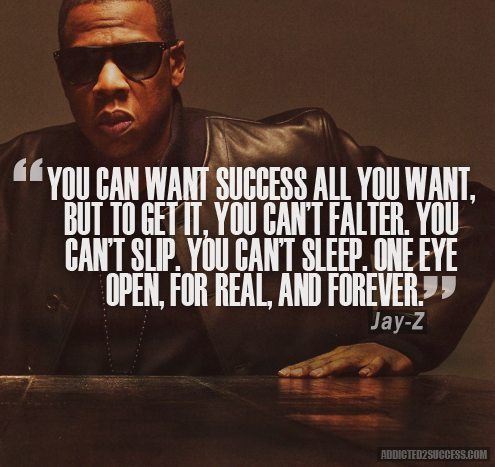
Jay-Z-Inspirational-Quote-Addicted2Success

 7. You Have to Speak Up

Whether you’re afraid to get clarification or afraid of adding your opinion in an important meeting, you’re holding yourself back from success. Every question and every idea is valuable, and the most successful people recognize this. You don’t have to be the best at public speaking to share your ideas, but it doesn’t hurt to brush up on your public speaking with some of these tips.

 8. Success Doesn’t Depend on Your College Major

If you take a look at the college majors of billionaires, you’ll notice they come from different backgrounds. It doesn’t matter whether you’re a STEM or liberal arts graduate. What matters is what you do with what you know, and how you integrate knowledge from other fields in order to succeed.

 9Success Can’t be Planned

Despite what you’re taught in school, you don’t have to plan every detail of your goals to be successful. Stop worrying over the details of what’s going to happen down the road, focus on the actions right in front of you and take it one step at a time.

 10. Success Looks Different for Everyone

To you, success might mean living in a fancy mansion, eating five-course meals every day and being doted on by a gaggle of beautiful women/handsome men. To someone else, it might mean not having to use a park bench as a makeshift bed anymore. Avoid judging people based on their aspirations; for all you know, it could the only thing keeping them alive.

 11Success Wins You Both Friends and Enemies

 No matter what you do, your success won’t please everyone. Some people will flock to you, hoping that some of your good fortune will rub off on them. Others will try to find the tiniest, slimmest cracks in your veneer, and badmouth you at every opportunity. A few will be genuinely happy and supportive of you; these are the people you keep close at all times.
13655133194c513

 12. Success Can Be a Burden

 When you’re successful, you attract attention – unwanted or otherwise. You get praised if you’re a good role model, and vilified if you’re not. You have to fight to keep your real self intact, and not let success go to your head or define you.

 13. Success Isn’t Just About You 

If you ever get invited to discuss your secrets of success, remember to acknowledge the contributions of the people who helped you get to the top. You never know when you might need their help again.

 14. Success Magnifies Your Traits – For Better or Worse

Warren Buffett once said: “Of the billionaires I have known, money just brings out the basic traits in them. If they were jerks before they had money, they are simply jerks with a billion dollars.” Coming from one of the world’s richest men, that’s saying a lot.

 15. Success Tests You on Multiple Levels 

Aside from magnifying your personality traits, success tests you. It tests how far you’ll go to keep it, by making every single one of your choices seem heavier than they really are. When this happens, remember: As long as you’ve always kept it real, most people won’t fault you for being human.

 16. Success Is Like Driving

Everyone can learn the basics of driving, but only the ones who actually go out there and drive will get anywhere. Also, if they manage to survive real road dangers – such as grizzly bears suddenly jumping in front of them – they become better drivers for it.
“Formal education will make you a living; self-education will make you a fortune.” –Jim Rohn 
Success is a strange thing, isn’t it? It somehow manages to be simple and complicated at the same time. Regardless of how you define success, keep the above mentioned lessons in mind, so you’ll be able to achieve success in your own time, on your own terms.