Interest in essential oils and their healing ability is at an all-time high. The more we learn about the amazing benefits of essential oils, the more it seems we want to learn. Nature has provided us with a potent array of natural anti-cancer compounds in common citrus fruits. Lime, lemon, orange, grapefruit, and tangerine all possess plenty of healing plant nutrients − and the essential oils derived from the rinds of these fruits are no exception.
Citrus essential oil has been used for centuries for relief from colds and flu. These oils have also been used for cleansing, purification, digestion, skin complaints, disinfecting and so much more.
Ancient healers might not have known it, but modern science confirms that citrus essential oil contains an interesting array of natural phytochemicals (plant-based chemicals) that have anti-cancer properties. Scientists have been studying the phytochemicals found in citrus essential oils for decades.
It’s All About Limonene
At first it was thought that the anti-cancer activity of citrus essential oil was mainly due to the high levels of antioxidants they contained. Closer inspection found that it had mainly to do with one special phytochemical found in citrus known as limonene. There are now over 200 research studies on limonene discussing its anti-cancer benefits.
The limonene content in citrus essential oil depends a little upon the growing conditions of the fruit trees and many other factors, but generally speaking, citrus oils contain significant quantities of limonene.
Limonene Content in Citrus Essential Oils
Lemon essential oil: 59-73% limonene
Lime essential oil: 50-60% limonene
Orange essential oil: 85-96% limonene
Tangerine essential oil: 85-93% limonene
Grapefruit essential oil: 88-95% limonene
Lime essential oil: 50-60% limonene
Orange essential oil: 85-96% limonene
Tangerine essential oil: 85-93% limonene
Grapefruit essential oil: 88-95% limonene
Other phytochemicals found in citrus essential oils include perillyl alcohol, alpha-pinene, beta-pinene, myrcene, and a few other minor constituents. All of these phytochemicals have research indicating they also have potent anti-cancer activity. But by far the most studied phytochemical is limonene.
Extraction and Potency of Citrus Essential Oil
Citrus essential oils are mechanically cold pressed using the rind of the fruit. Because a good amount of essential oil can be extracted that way, citrus oils are not overly expensive, especially when compared to some other essential oils.
It takes about 1,000 lemons to yield one pound (454 grams) of lemon essential oil. By contrast, it takes around 10,000 pounds (4,536 kilos) of rose petals to yield one pound (454 grams) of rose essential oil. As you can see, citrus yields much more oil by weight than do rose petals, and they are priced accordingly. Rose essential oil is one of the most expensive oils to purchase.
It takes about 75 lemons to make one 15ml bottle of lemon essential oil, so citrus essential oils are extremely condensed and potent.
6 Great Ways To Use Citrus Essential Oil
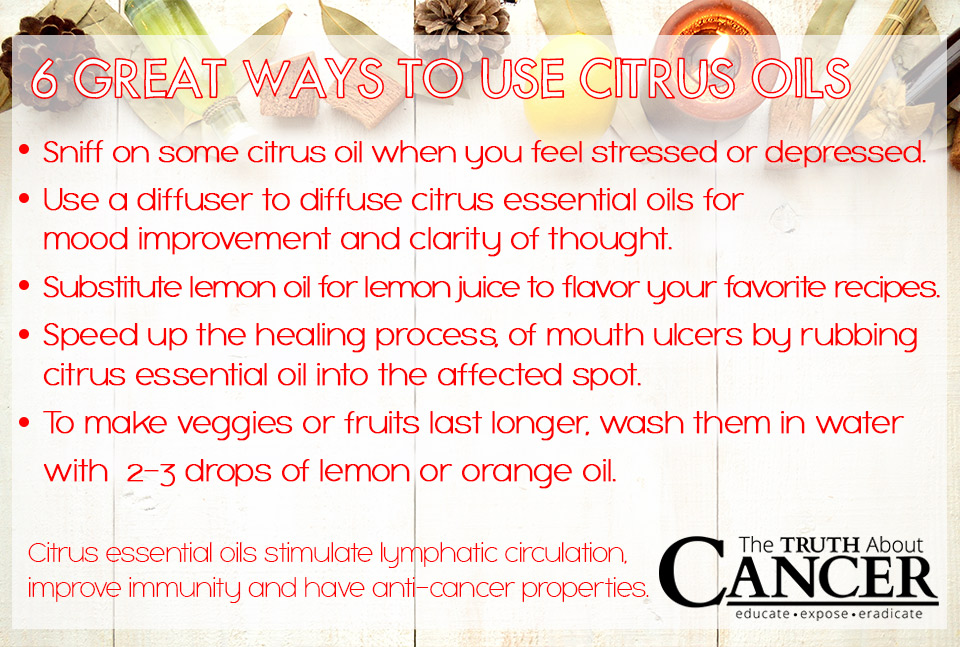
1. Put a drop or two of lemon, lime, orange, or tangerine essential oil into your favorite juice or sparkling water for an extra wallop of anti-cancer potential and to encourage the elimination of wastes and toxins. The limonene content stimulates white blood cell production, improves the body’s ability to combat infection, and helps to detoxify the liver. Please use only glass containers as essential oils eat plastic and make sure your oils are labeled as therapeutic grade and safe for internal use.
2. Cancer patients undergoing chemotherapy often suffer from mouth ulcers. To speed up the healing process, rub a drop of your favorite citrus essential oil into the affected spot as frequently as you can remember to do it.
3. Feeling stressed or depressed? Just open the cover of your favorite citrus essential oil and breathe it in. Orange in particular helps to balance the emotions, either relaxing or stimulating as needed. Lemon refreshes and brings clarity of thought.
4. Using a purpose built cool mist diffuser, you can diffuse citrus essential oils for mood improvement and clarity of thought. A combination of orange withpine essential oil and cinnamon is wonderfully uplifting.
5. Substitute lemon essential oil for lemon juice or zest to flavor your favorite recipes.
6. Add shelf life to organic fruits and vegetables by filling a bowl or small bucket with cold water, adding 2-3 drops of lemon or orange essential oil and drenching your produce in the water. Rinse and refrigerate them afterwards.
As a breast cancer coach, I teach my clients how to use certain essential oils for health improvement. For instance, to improve breast health I recommend massaging the breasts daily using a combination of a favorite citrus essential oil with either frankincense, lavender, or sandalwood (just to name a few). A few drops of each is usually sufficient.
Citrus essential oils stimulate lymphatic circulation, improve immunity, and the anti-cancer properties of these oils are well documented.
The Research on Limonene’s Anti-Cancer Benefits
There is plenty of scientific research on citrus essential oils, and especially on limonene. One 1984 study found that rats fed limonene had a 72% reduction in mammary tumors as well as regression of existing mammary tumors − with no toxicity.
A 1994 study (also on rodents), found that limonene helped not only to prevent mammary carcinomas but also had anti-tumor effects.
How much limonene was necessary for the animals to experience tumor regression and prevention? One interesting 1992 study found that a diet containing 7.5% limonene was sufficient for mammary tumors to completely regress.
That’s all very well and good for animals, but does limonene work for humans?
A 2015 study on human pancreatic cancer cells in vitro (in test tubes) found that limonene inhibited the growth of the cancer cells. It also inhibited cellular proliferation (rapid reproduction of a cell). Limonene also promoted apoptosis (programmed cell death cancer cells). Researchers noted that limonene had “cancer specific toxicity.”
A small 2013 study on 43 women with newly-diagnosed breast cancer (all of whom chose surgery) had some interesting results. The women took two grams of limonene per day for two to six weeks prior to surgery. The results indicated that limonene concentrated in breast tissue and reduced cyclin D1 expression in tumors. Cyclin D1 is a protein involved in the life cycle of cells. By reducing its expression, it is thought that this may lead to cell-cycle arrest and reduction in tumor cell growth.
An interesting 2015 study on 40 early-stage breast cancer patients indicated that limonene had a general systemic effect on them. The patients experienced several results, but most notably a decrease in the circulation of adrenal steroid hormones.
Since estrogen is a steroid hormone and tends to have a proliferative effect, reducing circulation of estrogen via natural means could be significant for breast cancer patients. The women also experienced an increase in bile acids, important for aiding absorption of dietary fats, elimination of liver wastes, and reduction in cholesterol levels.
Studies on limonene and citrus essential oils are being released all the time. It is always exciting to discover what other roles citrus essential oil can have in cancer prevention and treatment, so stay tuned!
3 Things You Should Know BEFORE Using Citrus Essential Oils
1. Quality is important! You want to know where your essential oils come from and whether or not the fruit has been sprayed with pesticides. Pesticide residue concentrates in the rind of citrus fruit which, as mentioned above, is where the essential oil comes from. It is best to avoid essential oils from companies that do not tell you how the fruit for their oils is grown. Organic, or at least spray-free, is best.
2. Using citrus essential oil on your skin can make the skin photosensitive − meaning that if the skin treated with citrus oils is then exposed to the UV rays from sunlight, sun lamps, or tanning beds, it can burn more easily or react with a rash. To avoid this, simply shield the skin treated with citrus essential oils from any possible UV rays for at least 6 hours after application.
3. Because grapefruit is known to react with many medications, it is advised to avoid the use of grapefruit essential oil until you’ve checked with your health care practitioner.
General note: When using essential oils to enhance your health, it is always a good idea to do your research and/or work closely with a qualified practitioner.
By Marnie Clark