Showing posts with label fears. Show all posts

Thursday, 28 January 2016

Overcoming Imposter Syndrome So You Can Thrive and Shine

Let Yourself Shine
“We ask ourselves, who am I to be brilliant, gorgeous, handsome, talented and fabulous? Actually, who are you not to be?” ~Marianne Williamson
I’ve been dreaming about dead bodies again—disposing of dead bodies. Given that I have never actually killed anyone it’s probably a little weird how often this crops up for me. My dream metaphors tend to be blatant and graphic. I think my subconscious mind really wants me to pay attention to them.
I don’t have recurrent dreams per se, but I do get recurring dream themes. Lately my subconscious has been knocking me over the head with images around hiding things I don’t want others to see (thus the dead bodies) and frantically looking for things that I can’t find.
Last night three people were impatiently waiting in expectation for me to produce a simple receipt, we all knew exactly where it was supposed to be, but damned if I could find it.
I used to Google dream interpretations and ask people what they thought it all meant. But I have come to realize that our dreams, and the imagery contained within them, are as individual and personal as we are. And if we really think about it, we know exactly what they are trying to tell us. Sometimes we may not want to know, but the information is always there if we seek it.

Fears and Doubts

It’s no coincidence that these images are popping up at a time when I am involved in a new creative project that is beginning to show the light of possible success.
I know that these dreams are a reflection of my doubts and fears. Fears around exposing myself to judgment, even ridicule, have me spending my nights “burying” aspects of myself. Doubts around losing my creativity have me frantically “searching” for it as I sleep.
I read the book Fight Club years ago, and it quickly became one of my all time favorites. I love that book. So of course I sought out and read a couple more by the same author. And I hated them. I decided that Chuck Palahniuk only had one good story in him.
Maybe he has written good books in the meantime—and of course my opinion about it is totally subjective anyway. But for me it reflected, and confirmed, my fears and doubts about my own creativity. That fear cemented in my mind. What if my well of creativity is finite? What if I actually do become successful, and there is nothing left for me to give?
I don’t really think creativity works that way. It strikes me as more like something that grows and expands the more you use it. Once you take the lid off and let it start flowing, there is no going back. You probably can’t stop it if you tried; it is that powerful a force. (I wish I had discovered that years ago, but apparently I am a very late bloomer.)
But regardless of our conscious beliefs, our fears can be hard to shake, and often run like gremlins in the background, poking at us from our subconscious, and causing us discomfort.

Imposter Syndrome

Many people assume that failure is our biggest fear, and it can look that way. But in reality a bigger fear, for many people, is the fear of success.
Success is frightening because with it comes expectations, not the least of which is the expectation that that success will continue. We sometimes attribute small successes along the way to being the result of fluke or luck, and fear that we will be “found out” as unable to sustain greater success.
In both creative and other endeavors, the fear of obtaining a measure of success only to be exposed as unable to maintain whatever it took to get us there, or as unworthy to have obtained it at all, can manifest as imposter syndrome.
Imposter syndrome—the fear that people will find out that we have been BSing our way through life and really don’t know what the hell we are doing—is, if not universal, at least pervasive.
Nobel laureate Maya Angelou once said: “I have written eleven books, but each time I think ‘uh oh, they’re going to find out now. I’ve run a game on everybody, and they’re going to find me out.’”
When I think back to my childhood, I looked up to the “grown ups” as the people who had it all together, who knew it all. As I grew up I kept waiting for that feeling to kick in for me—that feeling of being grown up and competent—but it never did.
At some point I realized that it never would, and I wondered if everyone around me felt the same way I did: that we are really all those same children, just in a grown up bodies, continuing to stumble our way through life.
While it is enlightening, and somewhat comforting, to realize that others (even Maya Angelou) experience similar fears, it is also a little frightening.

Invisibility

One might think that failure is the opposite of success, but in reality I think it is invisibility. Invisibility is comfortable, and safe, but it’s not particularly challenging or inspiring.
When we come to a point in a given situation where when comfortable just doesn’t cut it anymore, where the fear of remaining stuck and invisible outweighs our fear of success (or failure, exposure, embarrassment, or whatever else is waiting for us in the unknown) we push past that fear and put ourselves “out there.”
But still our imposter syndrome fears may be there, lurking in the background. Bringing them into our conscious awareness is key to lessening their power over us.
For me, that often means paying attention to my dreams, especially those that give rise to uncomfortable feelings (as disposing of dead bodies tends to do). Delving into our uncomfortable feelings can be confronting, but there is power in it.

Worthiness and Shame

Imposter syndrome, and fears that arise around success and failure, are often manifestations of deep feelings of unworthiness. So our innate and inherent worth is forgotten, and we can be plagued by vague feelings of shame.
Is it any wonder that many of us fear success? That we fear the exposure of our shame and unworthiness to the world? We sometimes decide that remaining invisible is the better choice, and self-sabotage our efforts.
But what we fail to realize is that we are born worthy. There is nothing we have to achieve or prove in order to enjoy that worthiness, even if we have allowed our true worth to become buried under a lifetime of perceived mistakes, failures, and self-recrimination.
We can start now, in this moment, remembering and reclaiming our inherent worth and value. And we can begin to shine our own unique light on the world.
Fears, doubts, and limiting beliefs tend to thrive in the darkness. By shining a light on them we begin to loosen their hold on us.
The simple act of acknowledging our fears to ourselves is the first step to challenging them. Going a step further and acknowledging them here, for the world to see, is even more empowering. There is freedom in that. If we have nothing to hide, then perhaps we have nothing to fear.
Shining spotlight image via Shutterstock

Monday, 12 October 2015

10 Things To Do To Change Your Life Forever

Skier
“Change is the law of life. And those who look only to the past or present are certain to miss the future”
~ John F. Kennedy
The one constant thing in our life is change. We cannot avoid it and the more we resist change the tougher our life becomes. Trust me, I know this because I was very skilled at deflecting change in my life. We are surrounded by change and it is the one thing that has the most dramatic impact on our lives. Change has the ability to catch up with you at some point in your life. There is no avoiding it because it will find you, challenge you, and force you to reconsider how you live your life.
Change can come into our lives as a result of a crisis, as a result of choice or by chance. In either situation we are all faced with having to make a choice – do we make the change or not? I believe it is always better to make changes in your life when you choose to rather than being forced to.
We however cannot avoid the unexpected events (crisis) in our lives because it is these events that challenge our complacency in life. What we can control when we are experiencing these challenging events, is how we choose to respond to them. It is our power of choice that enables us to activate positive change in our lives.
Acting on our power of choice provides us with more opportunity to change our lives for the better. The more opportunities we create to change our lives the more fulfilled and happier our lives become. Here are 10 things that you can do in your life that will change your life for the good, forever:

1. Find Meaning In Life

Spend some time trying to sort out what is important in your life and why is it important. What is it that you want to achieve in your life? What are your dreams? What makes your happy? Your meaning in life gives you purpose and sets the direction of how you want to live your life. Without meaning you will spend the rest of your life wandering through life aimlessly with no direction, focus, or purpose.

2. Create A Dream Board

When we were children we would daydream all the time. We were skilled at dreaming and visualising what we would be when we grew up. We believed that anything was possible. As we grew into adults we lost our ability to dream. Our dreams became hidden and once we started to feel like achieving our dreams was impossible.
A dream board is a great way for us to start believing in your own dreams again. Seeing our dreams every day on a dream board brings our dreams to life. Our dreams become real and we start to have believe in the possibility of achieving these dreams.

3. Set Your Goals To Achieve Your Dreams

Once you know what is important in your life and what your dream life looks like for you, you need to take action and set your long-term, medium, and short-term goals. It is acting on these goals that enable you to achieve your dreams
Remember your goals may change. Always be flexible with setting and achieving your goals as things in life change and your goals need to reflect these changes. It’s the small steps that you take that create the momentum for change to happen in your life.

4. Let Go Of Your Regrets

Regrets will only hold you back in life. Regrets are events of the past and if you spend all your time thinking about the past you will miss the present and the future. You cannot change what you did or did not do in the past, so let it go. The only thing you have control over now is how you choose to live your present and future life.
I had a heap of regrets that were holding me back in my life. I came across the “Balloon Exercise” and got rid of my regrets for good. What is it? It’s simple — blow up as many balloons as you need. On each balloon write a regret and then let the balloon go. As the balloon drifts off into the sky say goodbye to that regret forever. A simple and powerful exercise that works and can change how you live your life.

5. Choose Some Really Scary Things To Do And Then Do Them

This is all about you choosing to step out of your comfort zone. Public speaking is one of the most frightening things anyone can do. I was petrified of public speaking however, I knew that I wanted to be a motivational speaker. So I joined Toast Masters to overcome my fear of public speaking. My first speech was terrible, my knees were knocking, I broke out in a sweat and I couldn’t stop shaking. But I did it and the feeling of completing this speech, even though it was terrible was great. I chose to keep going and now I earn a living as a motivational speaker. I am still nervous when I get up to speak however it is an excited nervous and I love it.
Make a list of scary things that you would kind of like to do but are too afraid to. Put a plan in place and then go do them. Never stop doing scary things because if you do your life will become one of complacency and comfort.

6. Start Living A Well-Balanced Life

Our health does not remain the same. Our physical, emotional, and spiritual state changes, as we get older. What we can control however is how we feed our minds and our bodies. Living a balanced and healthy life builds our resilience to the physical changes of our body. Exercise is the best way in which we can attain a positive and optimistic attitude toward life.
Living a healthy, well-balanced life with lots of exercise is a lifestyle choice that without a doubt will give you a happier more satisfied and fulfilled life.

7. Face Your Fears

Its easy to ignore our fears and hope that they will go away. Unfortunately, it does not work like that. If you want to change your life, learn to master your fears so they can’t control you any longer. Our fears are only thoughts in our minds that are not real but over time we have become to believe that they are true. It is our fears in life that stop us from living our life to the fullest. We know when our fears are controlling our lives because we feel discontent, dissatisfied and unfulfilled.
Once we face our fears we take back our power to choose how we want to live our lives and when we do this we change our lives forever.

8. Accept You

The only person who is going to create change in your life is you! and to create that change you have to like you. There will be times in your life where you will face rejection and there will be people who will not like you that much. Accepting who you are and loving yourself helps you to move forward in your life. Putting yourself down all the time and wishing you could be better will only lead you to a life of unhappiness and discontent.
Find your courage, love yourself, and step out and do something crazy. Don’t worry about what anyone thinks or whether it is the right thing to do. In your heart if it feels right, act on it and go create the life you love.

9. Live In The Moment

Many of us tend to think that the grass is greener on the other side. Often, we get to the other side of the fence we find that this is not so. The motivation to change our lives comes from our desire to be happy. We are often so busy focusing on our pursuit of happiness that we miss the joy of actually living in the moment. Our desire to have happiness in our lives is a desire of a future state not of the present. We become so consumed with all our problems and discontent in the present we miss the precious beauty of the moment.
Sitting on the beach eating an ice-cream with your best friend or partner is a moment of happiness. Appreciating and showing gratitude on a daily basis is experiencing happiness in the moment. Helping those in need brings joy and happiness to us. This is what living our life in the moment is all about – don’t miss these moments because you are too busy focusing on your pursuit of happiness.

10. Experience The Joy Of Learning

Each time you learn something new you gain more knowledge and with more knowledge comes more confidence. Learning helps us to be more adaptable and flexible to new situations. Learning encourages us to be more creative and innovative in our thinking and we are therefor more comfortable with the unknown.
Reading books is a great way for us to learn. To fully embrace the joy of learning, never stop reading nor searching for more knowledge. Learning gives our life meaning and this is what makes our life worthwhile.
You have a choice to make as to how you want to change your life. Choosing to act on these 10 things will, without a doubt change your life forever. So what are you waiting for? Go do these 10 things now!
Love this article? Share it with your friends!

Monday, 4 May 2015

10 Myths About "Healthy" Relationships

Each one of us carries ideas around about what a healthy relationship looks like or "should" look like. This typically comes from our upbringing, the relationships we see around us, and more. Yet these common beliefs about "healthy" relationships often create and reinforce stereotypes, many of which can do more harm than good.
While maintaining standards for what you want a "healthy relationship" to look like is a totally OK thing to do, many of these thoughts are just cultural myths that oversimplify issues most relationships inevitably face.
Identifying the relationship myths that we hold can be beneficial to the overall health and longevity of our relationships, as it frees us from making assumptions and helps us to live more in the present moment.
Here are 10 myths about so-called "healthy" relationships that many of us may have.
1. “Conflict means the relationship isn’t healthy.”
This is quite the opposite actually. The total absence of conflict in a relationship is more a red flag that problems are being repressed rather than discussed. By allowing conflicts to happen, both partners openly acknowledge and work through issues, which, by the way, are basically unavoidable in any relationship, romantic or not. In doing so, the relationship deepens and becomes stronger.
2. “We both have to have the same views on everything.”
Do we need to accommodate all of our partner's needs 24/7 in order to be with them? Sure, but only to some degree. That is, we don't have to agree or be on the same page about every single thing in order to have a healthy relationship.
Two people can have wildly different view points on things and still have a healthy relationship. After all, there are people in this world who have healthy relationships despite differing religious/spiritual views, cultural backgrounds, and political views. It boils down to a matter of both people accepting and respecting one another.
3. “A happy and fulfilling relationship requires having common interests.”
Though having some common interests can make it easier on what to do on a Saturday night date, it’s not an absolute deal breaker. What matters more is that there is a lively dynamic between you two, and one characterized by feelings of love and support.
4. “There is a certain criteria that all must follow in order to have a healthy relationship.”
This myth is the paramount myth: the mere idea that there is one ideal of a "healthy" relationship.
But when you think about it more carefully, doesn't it seem obvious that there's no “one size fits all” criteria? Everybody is different, and very complicated, so why shouldn't our relationships be that way, too? Each of us has our own fears, desires, neuroses, needs, past experiences and more. That's why we have to do what works for us and our particular relationship.
5. “As long as I really try to not do what my parents did, I will have a healthy relationship.”
The problem with heavily focusing on not doing what our parents did is this: We may end up trying so hard to not be like our parents that we end up causing other problems. So we must focus more on healing ourselves rather than to simply avoid doing what our parents did.
6. “There will always be romance.”
The romance may last a few years, but the truth is that it’s going to calm down at some point or another. It’s not something that is just going to always be there automatically.
7. “If I’m with the right person, I won’t have to really work that hard at it.”
Any one individual is incredibly complicated. So once you put two people together, everything becomes so much more so. I like to think that our relationships are assignments to help us grow and evolve. The challenges that come up during our relationships invite us to examine ourselves, and undergo some personal growth every single day.
8. “In order for this relationship to work, my partner must change.”
The reality is that we have no control over our partner or anyone else in our life. The only person that we have control over is ourselves.
9. “Being in a healthy relationship means my partner is going to know my needs and meet them all the time.”
It is not anybody else’s responsibility to take care of you and your needs. Only you are responsible for that — just as your partner is responsible for their own needs as well.
10. “All we need is love to make a marriage work.”
When it comes to marriage, there are a lot of things to deal with: finding a place to live, working with finances, deciding whether to have kids and, if so, deciding on how they are going to be raised.
Sure, love can be a motivator to get us to work through these things together but we can’t just say, “Oh, all we need is love” and brush the rest under the rug thinking it will just “work itself out." All these factors need to be openly talked about and agreements need to be made.
What are some myths about healthy relationships that you can think of? Share them in the comments below!
Photo Credit: Stocksy

Friday, 1 May 2015

Why Love Isn't About Finding The "Right" Person

All my life, no one told me what love really was. No one ever taught me what a relationship was supposed to be like. I had only two models.
One was my parents, who spent most of their time at best either bickering or tolerating each other.
The other was popular culture, in which a relationship is portrayed as the highest good between two people, the end point of the story, the happily ever after.
And between these two models was a wide gulf that only love could supposedly bridge. It was supposed to come on like a magic spell, and then suddenly make everything easy, fulfilling, complete. Forever. The magic pill of love.
That may be how it works for some people. But certainly not for me. And after reeling from the wreckage of another failed relationship, I decided to search for love. Not for a person: I’d tried that enough to come to the sobering conclusion that the problem wasn’t other people, it was me. But for a capacity within myself to love.
And this is what I learned: All problems in relationships are historical. They have to do with one, or usually both, partners bringing the wounds of the past into a present interaction.
It is the partner who was abandoned by his mother as a child, who then clings onto his girlfriend, in need of constant reassurance that she won’t leave him, thus reinforcing his fear that he’s unlovable.
Or it is the man who was smothered and over-controlled by his mother, who then resents his girlfriend, terrified that if she gets too close, she’ll suck the life out of him like his mother did.
In other words, it is so many fears, complexes, and projections that we load onto someone else as soon as love begins to take root.
(Generally, with heterosexual relationships, look at someone’s relationship with the opposite-sex parent to determine their attachment style; for homosexual relationships, look at the same-sex parent.)
Because, it turns out, love is not something to be learned. It’s something we already have, and ironically perhaps, we must unlearn to reach it. The goal? To become, as the poet and singer Patti Smith once told me in an interview, “the clean human being that I was as a child.”
And so, contrary to what so many people spend their lives believing, love is not about finding the right person. It’s about becoming the right person.
I am writing this post not just to share a few of the many things I learned on the road to love, but as a consequence of a discussion with mindbodygreen founder Jason Wachob. I was asking him about possible titles for the book I spent four years researching on love, relationships, and commitment, and we decided to ask the people who know best: you.
So which of these books would you most be excited to either read or buy for a friend who needs it? Check them out here.
A book title is like a handle. It allows someone to easily carry the hundred-thousand words packed inside. Knowing what handle you’d most want to lift up and bring into your life would mean a lot, and would help me resolve a discussion with the publisher.
Thank you for your help, and I will be back soon to let you know the results and share a longer list of knowledge and tools that you can start immediately applying to your relationships.
Photo Credit: Stocksy

Friday, 13 March 2015

How To Do Tapping – EFT Techniques For Beginners

With just a little basic instruction, you can start Tapping your way to better health, more self-esteem, more abundance and a more peaceful mindset right away.
The exercises are simple, fun, and effective – and results can be nearly instant. Just gently tap your fingertips on your meridian points, while at the same time verbally identifying and acknowledging the problem. While you’re tapping, repeat your thought-changing affirmations, visualize your desired outcome, and overcome your limiting beliefs in just minutes. It’s that simple!
Tapping can be done anytime, anywhere, for fast self-reprogramming results in any area of your life that needs a boost.
 A Beginner’s Guide to Tapping
The verbal commands (affirmations) are spoken while simultaneously lightly tapping the body’s meridian points with your fingertips. Stimulation of these Chinese acupuncture points in combination with psychological techniques helps release mental blocks and their physical manifestations.
The technique is extremely effective because it addresses the source of the fears. Often, this is enough to release the fear. A combination of Tapping and verbal commands will remove even the most stubbornly held fears. 

Which Fears to Address First?

Many of us hold fears around various areas: fear of rejection, fear of being alone, fear of failure, fear of success, fear of pain, fear of poverty, etc. So where do you start?
Typically – and this may vary for you – fear of not being good enough, fear of failure, and fear of rejection are the three biggest fears that people have. Just pick an area of your life where you are struggling (wealth, health, relationships, or career/purpose) and focus on that one area. Targeting one area helps you focus on systematically solving one problem at a time. You may have a lot of crossover fear – for example, fear of not being good enough can manifest in all four life areas -  so addressing that fear in one area will create a ripple effect of improvement in other areas.

The Sequence

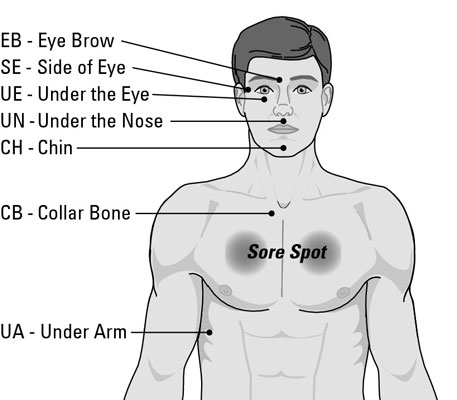
meridian points tapping
Credit: dummies.com
1. First, say a “setup statement” while Tapping. The setup statement identifies the problem and hints at the solution. While tapping the karate chop point on either hand, repeat the entire setup statement.
2. Next, perform the “negative tapping sequence” where the current situation is stated clearly and the source of the fear is identified, while gently tapping 7-10 times on each meridian point. Tap the:
    • eyebrow
    • side of eye
    • under eye
    • under nose
    • chin
    • collarbone
    • under arm
    • top of head

It’s important to focus your mind on the negative thought patterns that are causing a problem in your life. This is the process of releasing the negative thought patterns by becoming aware of them and acknowledging that they are not doing you any good but that they have been a part of your life for some time.
3. The negative tapping sequence is followed by tapping each meridian point 7-10 times while simultaneously repeating a different phrase for each point. This is the process of installing new thought patterns.
4. The exercise finishes with a deep breath to help move energy throughout the body. You may feel a huge release immediately or within minutes. You may feel physically unwell for a short time as the emotional toxins work their way out of your body. You may feel euphoric or sad. Whatever you feel is right and normal for you, as your body and mind process the experience.
In many cases, a single treatment addresses many issues. Even the most stubbornly-held beliefs and damaging phobias can be released in minutes; other complex fears may take time, as they may consist of several interrelated fears that all need to be addressed.
You’ll experience a huge motivational boost as you immediately feel the effects of Tapping and as those effects begin to manifest in your actions and your speech!