Showing posts with label health problems. Show all posts

Thursday, 9 June 2016

How To Get Rid Of Bad Breath With Apple Cider Vinegar

DD433G Apple cider vinegar in glass bottle and basket with fresh apples
Bad breath can be an embarrassing condition for those who suffer from it – and despite many products like toothpastes, mouthwashes and powders being out there, it can be a condition which is difficult to treat. Fortunately, apple cider vinegar offers a natural and inexpensive way to help take care of this problem and get your breath fresh again!
Read on to find out more about curing bad breath with apple cider vinegar.

The Lowdown on Bad Breath

While everyone understands what bad breath is, not many know much about its causes. The truth is, there are many things that can cause this problem. The Mayo Clinic notes that many of the usual suspects include:
  • Particles of food that get stuck in the nooks and crannies of and around the teeth
  • Bacteria build-up on the teeth and tongue
  • Certain medications
  • Eating certain foods, such as those with onions or garlic or which are heavily spiced (like a curry dish)
  • Some medical issues/conditions like gum disease, sinus infections, poor digestion or even cancer
  • Use of tobacco products
If you do find that your breath is not fresh, one of the first things you should do is to review your oral hygiene habits. Are you brushing 2-3 times a day, especially after meals and/or before you go to bed? Are you flossing? Do you make sure to brush your tongue along with your teeth? Are you using mouthwash? The answer to all these questions should be “yes” if you want to make sure that your mouth is both healthy and odor-free.
If you already do everything suggested above but are still having problems, consider adding apple cider vinegar to your daily routine.
Tea Box 
How To To Erase Bad Breath with Apple Cider Vinegar
So how can apple cider vinegar help you win your battle over bad breath?
First, apple cider vinegar has a high concentration of malic and acetic acid and because of these acidic properties, it can create an environment that is unfriendly to bacteria. This can help to kill off the bacteria on the teeth and tongue that could be causing the bad breath to begin with.
Second, apple cider vinegar contains a rich blend of minerals – including calcium, potassium, sodium, magnesium, copper, sulfur and other trace minerals that are all important to support the overall health of the mouth and teeth – as well as providing the rest of the body with these important nutrients.
Third, apple cider vinegar can help improve overall digestion, one of the possible causes for bad breath mentioned above.
  TrimFit

How to Use Apple Cider Vinegar

The best thing about apple cider vinegar is that not only is it cheap and available at nearly every grocery store, it really is affective at conquering the issue of bad breath. Below are various recipes for apple cider vinegar drinks, gargles and mouthwashes to help improve this problem:
Apple Cider Vinegar Daily Drink Recipe
  • 2 tablespoons apple cider vinegar
  • 1 cup (8 ounces) water
Stir the apple cider vinegar together and drink this daily after meals to help improve digestion and kill the bacteria that causes bad breath.
Apple Cider Vinegar Gargle Recipe
  • 1 teaspoon apple cider vinegar
  • 1 cup warm water
Use this as gargle and then swish the liquid around in your mouth before spitting it out. Be sure not to swallow this mixture as it can just make bad breath worse.
Apple Cider Vinegar-Parsley Chew
  • Small handful of fresh parsley
  • 1 cup apple cider vinegar
To combine the antibacterial properties of parsley and apple cider vinegar, simply dip the parsley leaves in the vinegar itself, chew them thoroughly and then spit them out.
Apple Cider Vinegar Mouthwash
  • 1/2 teaspoon apple cider vinegar
  • 1 cup warm water
Stir the apple cider vinegar into the water and use as a mouthwash, swishing it around your mouth and then spitting it out.
Baking Soda/Apple Cider Vinegar Brush
  • 2 tablespoons baking soda
  • 2-3 tablespoons apple cider vinegar
  • 1 cup water
Mix the baking soda and apple cider vinegar into a paste and brush your teeth with it as you would brush them normally, then rinse with the water, swishing and spitting the water out.
There is no best way to do this – it will depend entirely on your own preferences. However, all the recipes given above are effective ways to help cleanse your teeth of the bacteria and improve your digestion, both of which can, in turn, help improve your bad breath with apple cider vigar, and also your overall health.
The takeaway here is that while bad breath can be a complicated problem, apple cider vinegar can be the answer you’ve been looking for. And even better is the fact that it can be bought at any supermarket for mere dollars and it will save you a ton of money while freshening your breath once and for all.
Set a goal for yourself
I will know why I get bad breath and get rid of it.

Sunday, 3 April 2016

MASSAGE THIS POINT FOR 2 MINUTES EVERY DAY AND THIS WILL HAPPEN TO YOUR BODY!

massage point body

To be completely honest, when it comes to chronic conditions that disrupt the normal workings of the body, natural methods are better. Using pharmaceuticals for an extended period of time is not recommended and can often be very unsafe. However, natural methods are readily available for use without all the nasty side effects that come with prescription medication.
Once such natural method is traditional Chinese acupressure. Acupressure works by pressing points on the body that lie along energy lines or meridians. These lines run through the body and by pressing certain points, one can clear that line of any blockages. This will improve the flow of chi or qi and improve health.
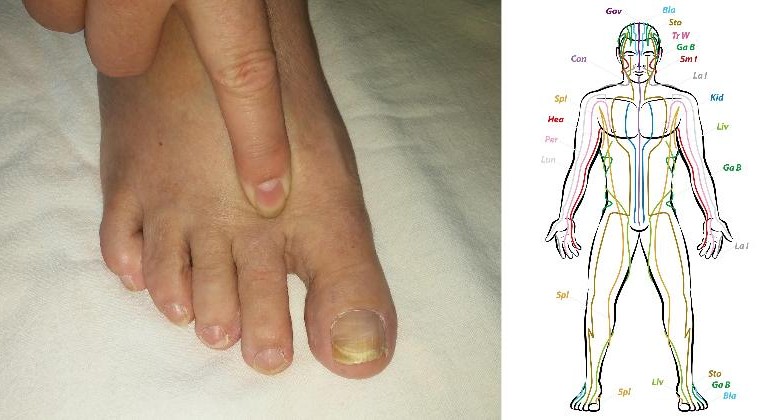
One such acupressure point on the body is called LV-3 or Tai Chong. Pressing, or massaging this point in small circles for two minutes every day has been found to treat a wide range of health problems.
These health problems include:
  • Headaches,dizziness, and canker sores
  • Blurred vision and red, swollen, or painful eyes
  • Nausea, vomiting, constipation, and diarrhea
  • Anger, irritability, insomnia, and anxiety
The LV-3 acupressure point is located a finger’s width above where the big toe and second toe meet. It should feel relatively soft to the touch.
Just pressing or massaging this point a couple of times a day for about two minutes is all you need to gain these benefits. I tried it out and found it to be super relaxing!

Take a look at the video below to learn more!


Who is giving this point a try?

Share in the comments!

(h/t: Sun Gazing)

Saturday, 3 January 2015

Healthy Living Day 3: Create Your Calorie List

Day 3: Create Your Calorie List

We eat every day. However, do you know the calories and nutritional information of the food you eat?
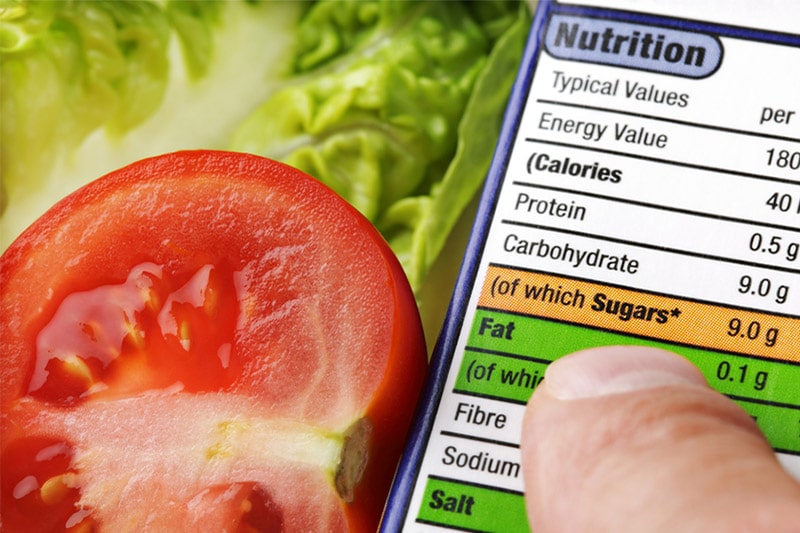
Calorie list
If you don’t, you’re not alone. Personally, I used to be totally ignorant about calories and food nutrition when I was a teen. To me, food was just food. If I was hungry, I would just eat whatever was available, usually something that I liked. If I was trying to lose weight, I would simply make myself eat lesser. That was it.
However, I gradually realized that things aren’t that simple. Let’s talk calories. I realized that one small slice of cake, despite not being very filling, can have as much as 500 calories. That’s one-whooping-quarter for a person with a 2,000-calorie expenditure, and one-third of if your daily energy expenditure which is only 1,500! (We’ll be talking about daily energy expenditure in Day 4.) I realized a simple chocolate drink from Starbucks can have over 400 calories. And I realized that pastries, cakes, sodas, and fried food, despite being calorie heavy, have little to no nutritional content.
While I had always thought that the objective of each meal was just to feed yourself with food, there is much more than meets the eye. For example,
  • I can have a McDonald’s Value Meal or a rice salad for lunch, and both will make me feel full. However, the McDonald’s meal will give me extremely little nutrition and load me up with carbohydrates refined sugars (leading to a blood sugar spike, which will likely cause diabetes in the long run), while the rice salad will not only give me sufficient calories, but will also load me up with good nutrients, make me feel full longer, and give me more energy.
  • I can consume french fries for 500 calories (512 to be precise for a pack of McDonald’s large fries) or I can have a healthy vegetable sandwich (without trans fat, preservatives, etc.) with a fruit for 500 calories. Yet, the former will make me feel bloated, give me zits, and again give me a blood sugar spike, while the latter will give me ample nutrients and great energy for a good half of the day.
Clearly, some food are more nutritious than others. And some foods (think french fries, cakes, many pastries, pasta / white rice, waffles, pancakes, ice cream, sodas, and sugared drinks), despite having a truckload of calories, have almost zero nutritional content.
Starbucks food and drinks
Examples of high-calorie yet low nutritional food and drinks that have — unfortunately — become a staple of modern society’s diet (Pictures fromStarbucks)
Unfortunately, many of us consume food without knowing its nutritional content! Because of that, we make poor food choices that don’t benefit our health, in turn leading to weight gain (or weight loss for some of us), loss of energy, and long-term health problems.
This is why today’s task is to create your calorie list — a list of food items you commonly eat, along with their respective calorie and nutritional information. While it may be a little bit technical (especially if you’ve never done anything like this before), the knowledge you gain will go a long way toward conscious eating and living a healthy life.
Let’s get started! :)
Step 1: Create a list of food items you commonly eat (10 min)
This should include
  1. Foods you plan to eat on an ongoing basis
  2. Foods you never want to eat but end up eating anyway
Be specific. If you eat fruits, don’t just list “Fruits” since there are many kinds of fruits and each have different nutritional value! A good, specific list will be like the one below:
  • Oranges
  • Apples
  • Green peas
  • Brown rice
  • Instant noodles
  • Pasta (Penne)
  • Chocolate brownie
  • Dressing (Thousand Island)

Step 2: Record their nutritional information (15 min)

Create 2 new columns beside the food items to record (a) Calorie content (1 calorie = 4.18 KJ) and (b) Fat content (g). Then, record the calorie content and fat content based on the typical serving size. The reason why I’m suggesting to record these two pieces of information is because
  1. Calorie is the overall measurement of energy. Whether you achieve your ideal weight or maintain your weight comes from whether you’re consuming the right calories relative to your daily energy intake. (We’ll be talking about energy intake tomorrow in Day 4.)
  2. Calorie is merely one part of living a healthy life – it’s important to track fat content as well. Unfortunately, we live in a society today that’s filled with high-fat food items, thanks to the prevalence of fast food and convenience food! High fat diets are slow contributors to many heart diseases and illnesses and it’s important to be conscious of the fat levels in our diets. People who consume little calories may look thin, but if they consume mainly high-fat food, then they are no healthier and are equally susceptible to poor health and heart problems.
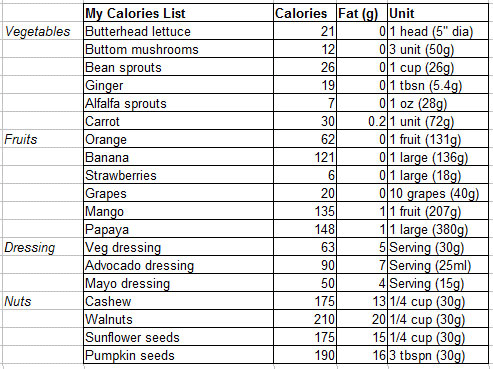
Here’s an example of my calorie list during the 2011 Healthy Living Challenge when I was on a high raw, vegan diet:
Example of a calorie list


Example of a calorie list for someone on a raw vegan diet

Now, certain established food chains (like Starbucks, McDonald’s, Subway) and processed food sold in supermarkets will come with nutritional information. If so, that’s great — record that in your table.
However, if you’re eating at restaurants or hawker centers, then you may be at a loss! Well, don’t fret! There are plenty of calorie counters online you can look up. Here are three:
  1. Calorie Count – An all-round counter with information (including carb, protein, fat, cholesterol, sodium, and dietary content) on possibly every food on earth. Over 250,000 foods in its database! I’ve used this counter for years and it works well.
  2. The Calorie Counter – Another calorie counter, in case you want an alternative!
  3. Nutrition @ SG – Live in Singapore and wondering what’s the calories in chicken rice? This site has the answers. (Warning: the answer may not be appetizing; Singapore hawker food tend to be high in calories and fat!)

Step 3: Track your calorie and fat intake today (10 min)

Now, as you progress through the day, record everything you eat and the portion sizes. Go about your day normally without restricting your food intake just because you’re tracking calories. The intent of this exercise today is be aware of the amount of calories you’re taking in with your usual eating habits.
Some things can be hard to track. For example, maybe your burger has a slice of lettuce and tomato. Maybe you have a salad that have 10 different ingredients. How are you supposed to track these things?
My answer? Focus on big rocks. If you have a chicken burger with chips, the significant items will definitely be the patty, the burger buns, and the chips. If you have a rice salad like I did in Day 2 with a variety of ingredients in very small quantities, then I’d focus on the main bits (the brown rice and white rice) along with the dressing, especially since the calories for vegetables are very low in general.
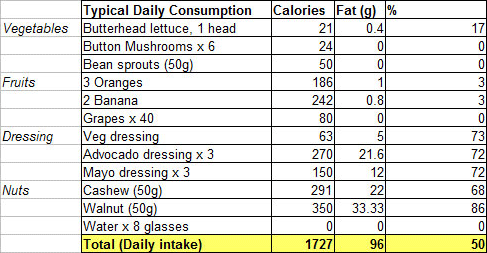
Example of a calorie list (actual daily intake)


Example of my calorie tracking for one of the days in the 2011 

Healthy Living Challenge. I subsequently realized that I was consuming

way too much fat than I wanted to, and it was only through tracking

my calorie/fat intake that I realized that!

After you’re done for the day, the big question comes to this: Are you overeating or under-eating every day? We’ll find out soon enough! Tomorrow / Day 4, we will be calculating our TDEE / Total Daily Energy Expenditure, which will help us identify our daily energy needs and the number of calories we need to eat daily to meet these needs.

Next, Follow Your Plan for Day 3 (Take Pictures Too!)

What tasks have you set for Day 3 of your 14-Day Healthy Living Plan? Do them today!
Take pictures of your healthy meals – breakfast, lunch, dinner, and mid-day snacks if any — and share them in the comments section. :D After all, a picture tells a thousand words, and when you share photos of your healthy meals, it inspires others to eat healthily and gives them ideas on what healthy food they can have too!
Post your initial comment sharing your results for today’s challenge task, then add on throughout the day as you have your breakfast, lunch, dinner, and/or if you’re doing any workouts. Attach photos of your meals by clicking the image icon on the bottom left of every comment box. As you add on to your comment thread, be sure to click on the reply button directly below your original comment so that you reply to your own thread (as opposed to starting a new thread).

Share Your Results (and Photos!)

Share in the comments section!
  1. Your total calorie and fat intake for today
  2. Your progress with your healthy living plan today
  3. Pictures of your meals
  4. Pictures of your workout (if any)
Do check out the other participants’ comments too and share a word of encouragement or two. We’re all in this together, so let’s support each other as a group! :)
Stay tuned for Day 4′s task tomorrow! :D