Showing posts with label values. Show all posts

Saturday, 9 July 2016

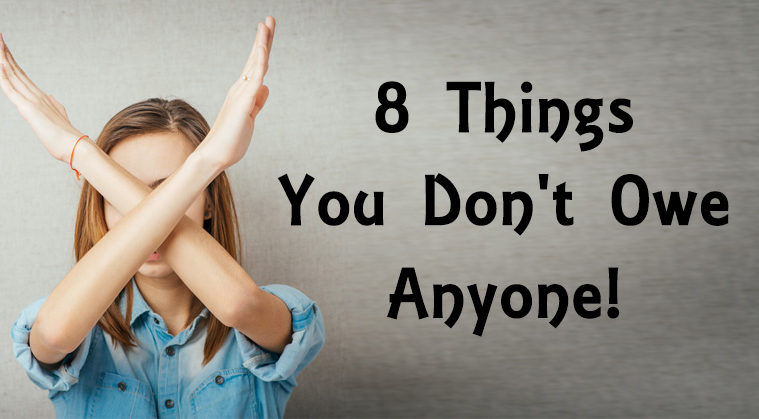
8 THINGS YOU DON’T OWE ANYONE!

dont owe FI
From family members to friends, coworkers and just about everyone else in life, it seems everyone’s got a pretty strong opinion regarding our choices.
Sometimes, people even go as far as to ask you to justify your choices.
You might think you have an obligation to fulfill those requests – particularly if you’re a friendly person who wishes to avoid confrontation.
But according to psychologist and blogger David K. William, there are certain questions that require no response other than “That’s none of your business.”
You can save yourself a lot of trouble and self-doubt by recognizing those questions and topics and standing your ground when they arise.
To help you do that, let’s explore…

8 Things You Don’t Owe Anyone An Explanation For

1. Your Living Circumstances

giphy (21)
Whether you live with your parents or by yourself in a condo, you owe absolutely nobody an explanation for the place you live.
Unless someone is offering to help you pay the bills, they have no right to ask ‘How do you afford to pay for this place?’ or ‘Aren’t you tired of living with your parents?’

2. Your Values

giphy (22)
It’s one thing when a friend inquires about your values in an attempt to better understand you and your worldview. It’s a completely different thing when anyone (including a friend) pressures you to justify your values in response to a particular decision you’ve made.
You don’t have to entertain that sort of pressure. State your values as respectfully as possible and continue to live by them. That’s all you need to do.

3. An Apology

giphy (23)
That’s right.
You don’t automatically owe someone an apology because they were offended by what you said or did. In fact, if you think you were in the right, don’t apologize at all. You’ll only make things worse.
If you’re not sorry, don’t try to mend open wounds by saying you are. Wait until you really do feel remorse. If you never do? Well then maybe what you did or said was the right thing.

4. Alone Time
giphy (24)
Whether you’re an introvert or not, you need alone time every now and again. It keeps you sane and focused.
Sometimes, when you decide to take that alone time, people respond negatively and accuse you of being anti-social or placing yourself above the social gatherings you may be neglecting for the sake of alone time.
It can be tempting to respond and try to justify your choice but it’s not necessary. You’re taking time for you. Unless the person questioning you has some sort of magic potion that’s going to instantly provide you with the pleasure that comes from alone time, you need not justify yourself.

5. Your Physical Appearance

giphy (25)
When it comes to your physical appearance, you are obligated only to yourself and your health. That’s it.
Disparaging looks from a stranger on the subway require no justification on your part. You don’t need to tell anyone ‘Hey, I suffer from _____ and that’s why I look like this.’

6. Your Sex Life

Some things are best kept private.
Whether you wait for marriage, sleep around or experiment with unconventional sexual situations, that’s your call. As long as you’re gaining consent, your sexual decisions are between you and your partner(s).
Your friends, your coworkers or people who like to gossip about you? They aren’t obligated to an explanation.

7. Your Political and Religious Views
giphy (27)
Is it possible to engage in a lengthy discussion without political or religious views being dragged in the mix? I’m sure it is. Not that you’d be able to tell based on the way many conversations seem to go.
You might feel the urge to justify your views and make the other person look like a fool for doubting them but let’s be honest. You’re never going to do that.
People are opinionated, especially when it comes to things like politics and religion. As long as your views make sense to you and do not infringe upon the rights of others, you don’t have to explain them to anybody. It’s not going to do you much good.

8. A Date
giphy (28)
Just because someone asks you for a date doesn’t mean they’re obliged to one.
Whether you’re male or female, you have every right to turn their request down without providing an explanation to them or anyone else.
Would it be nice of you to tell someone why you’re rejecting them? Certainly. But you don’t have to – especially if you’re not comfortable.

Can you think of any other things you don’t owe anybody an explanation for? Let us know in the comments!

brandonaustin

Thursday, 19 May 2016

3 Ways To Discover Your Values & Spark Happiness In Your Life


3 Ways To Discover Your Values & Spark Happiness In Your Life

Knowing your values means you know who you are, when you know who you are you know what brings you happiness (and what doesn’t).
Your values are your own moral compass, and without definition of them, you could find yourself in a job, relationship, friendship or home that doesn’t float your boat. And you’ll be left asking, “Why am I unhappy?”
To know why you are unhappy, you must know what makes you happy.
In the film The Matrix, the sign above the kitchen door of the character known as the Oracle says “Nosce temet,” which is a translation of gnōthi sauton, Greek for “Know thyself,” from the temple of Apollo at Delphi.
In other words, you must know thyself before receiving counsel is safe — as demonstrated in The Matrix, where the main character Neo must know himself before he’ll ever understand his destiny.
Or, as Socrates might put it, “The unexamined life is not worth the living.”

The famous saying, “Know thyself,” is termed perhaps the most important thing to aspire to in life. Translated back to its Greek origin, it actually contains the word, “Ouch!”
Ouch happens when ignorance is no longer bliss, but the closer we get to knowing ourselves the less the ouch becomes and the more our happiness shines through.

So what are values anyway?
Well they aren’t your beliefs. Beliefs are learned, usually from others or our own experiences, beliefs are self-fulfilling prophecies, but you also have the power to change them.
Values are internal. They are who you are deep down.
They are your sign posts to happiness (or unhappiness if ignored). They are your best friends when it comes to keeping your head, heart and life clear and easy (the more you get to know them that is).
Below are three ways to get to know your values, because it’s really important you are living your own life and not someone else’s.

1. Find your values

Ask yourself the following questions, and jot down your answers.
  • What makes you feel excited?
  • What makes you feel happy?
  • What makes you feel sad?
  • What makes you feel let down?
  • What makes you feel confused?
  • What makes you feel special?
  • What makes you feel respected?
  • What makes you feel angry?
  • What makes you feel hurt?
  • What makes you feel loved?
  • What makes you feel supported?
  • What makes you feel restricted?
  • What makes you feel insignificant?
  • What makes you feel embarrassed?
  • What makes you feel peaceful?
  • What makes you feel anxious?
  • What makes you feel shocked?
  • What makes you feel amazed?


Origins

2. Analyze your answers

Take a look at what you have written as your answers. So for instance if you have written that you feel let down when people don’t keep to their word then your value might be reliability, trust or honesty, so just jot down which one feels right to you. Do this for all 15.
Practice 2–8 value areas to think about. Then, score them 1–10 on happiness scale (7 or under needs attention)
  • Romance
  • Me time
  • Personal development
  • Career
  • Spirituality
  • Health
  • Money
  • Relationships
Think of two or three goals for each of the above and work on them!

3. Food for thought questions

Ask yourself some big questions to pinpoint what truly matters to you:
  • What do you want more of in your life?
  • What do you want less of?
  • What do you want to be best known for?
  • What would you really like to happen?
Maybe the effort to know oneself is self-indulgent or narcissistic. Or maybe not.
It is one of the great paradox’s of life that we cannot get to know ourselves without the mirror of others. So, for instance, in Plato, by gazing into the eyes of your lover, you gaze into a window of the self, therefore:
Take time to look at the values of those close to you too, so you don’t struggle against unknown assumptions within your relationships.
Once you and those important to you understand what’s important to each other the understanding and respect grows, so think about doing these 3 exercises with those important to you.

Monday, 14 December 2015

Fitting In Is Overrated: Embrace Your Uniqueness to Find Meaning in Life


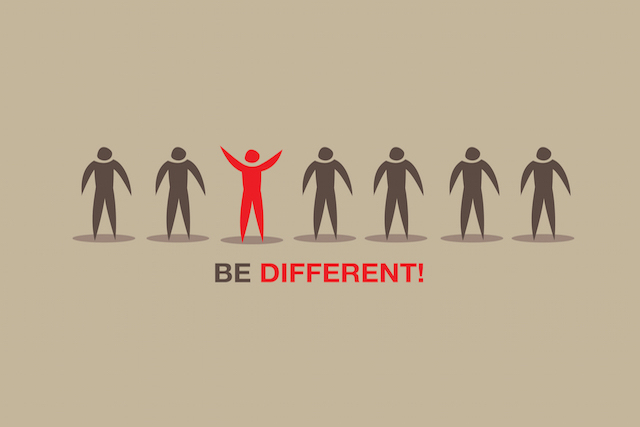
Be Different
“To be yourself in a world that is constantly trying to make you something else is the greatest accomplishment.” ~Ralph Waldo Emerson
Have you ever felt different—like you don’t fit in at all?
Do certain things captivate other people but leave you struggling to find meaning?
What about the big picture? Maybe you feel you chose the wrong career, or you wonder if you were born into the right family—no one else seems to think the way you do.
Feeling different can be unsettling in a world that values sameness. You can derail your confidence and your progress by demeaning yourself for your differences.
I felt uncomfortably different most of my life—out of place, misunderstood, and alone. I always worked hard to fit in, fighting a constant, frustrating inner struggle with no tools to help me cope.
I always got top grades, but didn’t seem to think the way everyone else did, perhaps because my family was poor but I attended an upper-middle-class school.
I was extremely introverted and shy in an extroverted world. I kept to myself, hiding so no one would know I was different. This broke my heart because I wanted to fit in so badly.
My desire to fit in continued through college and beyond. I finally realized I was wasting a lot of time and energy by struggling to fit in. I was denying my uniqueness and my chance to create a truly meaningful life.
By hiding my differences, I short-changed the very reason I was born.
Most of us don’t realize that hiding our true nature is devastating to ourselves and to the world.

How We Get Steered Off Course

Subconsciously, we’re all searching for true meaning in life. We think of it as trying to find happiness.
Society teaches us we’ll be happy by following norms that make us the same as others. We are encouraged to seek outside of ourselves rather than connecting inward and being fulfilled by the things we love.
For instance, we learn to:
  • Compete with each other to get into the best schools and to land and keep the best jobs.
  • Look for partners to give us self-worth and complete us.
  • Strive to make money to buy things to make us happy.
  • Do everything to stay young-looking, valuing youth more highly than age and wisdom.
With these goals, we are constantly doing rather than being. Time disappears because we aren’t embracing life by connecting with our inner being.
We forget who we are. We are not living. We are grasping for an elusive happiness on the outside.
We feel like we’ve found happiness repeatedly, only to realize it is temporary. Each time we find it slipping away again, we search to find happiness in some other way.
Embracing our uniqueness and finding true meaning in life will break the pattern.

Take the first steps toward freedom.

Changing direction requires some upheaval. But this is your life. If temporary discomfort results in discovering your meaning and purpose in life—which leaves you feeling fulfilled, balanced, and happy—isn’t change worthwhile?
Assess your life to see if you abandoned your own uniqueness just to fit the mold.
Review the five bullets above. Are you following someone else’s path instead of your own? If so, what would you prefer to do instead? It’s never too late to change.
If you’re seeking approval or self-worth from others, learn how to find these qualities within yourself. If you’re in a career that doesn’t satisfy you, acquire the skills you need to follow your passion.
What are you doing just to fit in? What daily activities feel like drudgery? What responsibilities or tasks do you often put off or even avoid?
A long list is a sure clue that you’re not following your passion. Seeking further can help you find true meaning.

Determine what makes you unique.

We all have a passion—something that makes us light up inside, something we want to do more than anything else. We bring our own uniqueness to our passion. Following it will help us find true meaning in life.
Assessing your uniqueness takes careful thought. Set aside an hour at a time. Longer blocks of time are even better. The key is to feel free to brainstorm because nothing else requires your attention.
Schedule time on your calendar and hold to it.
When it’s time, go to a quiet place with purpose. Take a notepad or something to capture your ideas. Don’t judge any of your thoughts. Brainstorming means all ideas are of equal value.
You can be selective later. Judging in advance blocks your creativity and you’ll likely miss something you are suppressing or something new.
Some questions to ask to uncover your uniqueness are:
  • Which activities cause me to completely lose track of time?
  • What am I always trying to find time to do even when I only have a few free moments?
  • What makes me really happy?
  • What matters most to me personally?
Once you have thought through and listed all your answers to these questions, list each answer on a separate line. Ask yourself what parts of your life feel most and least aligned with your favorite activities, passions and values.
Record and study this information closely to find clarity.

Leverage what you’ve discovered.

It’s time to follow your heart, honor your uniqueness, and discover your true meaning. Gather your answers and decide how to incorporate this newfound knowledge into your life.
Maybe you uncovered a passion you’ve always suppressed. For example, I always loved writing, but I only pursued it indirectly in the form of business writing because that was a practical way to earn a living.
Business writing is not my favorite form of writing, and it never satisfied my desire to write. But now that I have my own business, I’m writing the way I’ve always wanted to.
I’ve combined writing with my other passion of pursuing better ways to live. Now I’m excited when I write, I’m fulfilling my purpose, and I’m helping others.

Seek further if your passion still eludes you.

Maybe you’ve squelched your uniqueness for so long that you can’t find your truth. If you have more questions than answers, that’s great! That’s when it’s time to experiment.
Answers can come from many different sources, so cover a lot of ground. When you find clues, you can piece them together to form your plan of action.
Ask others what they do, find books and other resources to read, seek professionals to help you, join a group of like-minded individuals, take a class, or ask the universe. Use your creativity to reach out broadly. The answers will come.
Start exploring one area that calls to you. Try something creative such as art, theater, or science. Begin looking for solutions to your biggest problem, or reach out to help someone else. Life holds many right answers. Seeking and finding them is the fun part.
When I began my search for happiness, I looked everywhere. I even opened my mind to things I thought were illogical, like aura balancing. I was surprised when I discovered that I could actually feel negative energy being pulled out of my body by someone using a crystal.
That incident sent me to seek spiritual answers. Ultimately, I found my answers through the teachings of yoga. I was so motivated by these teachings that I moved into a meditation center for a year to pursue them.
This brought me around full circle, proving that I really am different—and because I found my passion, I learned that being different is completely okay. This changed my life radically.
Don’t be afraid to go out on a limb with your search. You never know where it might lead you. It is far better to follow your heart and be different than to struggle to try to be the same.
We all have differences in a world that values similarity. When fitting in means suppressing who you are and what you love the most, you miss your opportunity to connect deeply with yourself—to live, shine, find true meaning in life, and offer your unique talents to the world.
By opening your heart and mind and being completely free to explore what matters to you, you will learn who you are. Next time you find yourself holding back to avoid standing out, realize that you add value to the world.
Never be afraid to follow your passion and blaze new trails. It’s important to have faith in the process of life. The trick is to realize and embrace your uniqueness. By doing so, you will be led in the direction you were meant to go.
Be Different image via Shutterstock
By Jan Tucker

Saturday, 5 December 2015

You Are the Author of Your Life Story (So Write One You’ll Be Proud Of)

Your Story
“When writing the story of your life, don’t let anyone else hold the pen.” ~Unknown
I grew up without a TV in my household. While most of my friends were talking about their favorite shows, I’d pretend to understand, nod along, and try to laugh at all the appropriate times.
While I had missed out on most of the shows and movies available during my youth, I didn’t miss out on all of them.
Whenever my dad would need to work late, my mom, sister, and I would head to his office and get set up in a conference room with a rented movie. It was during one of these times that I was first exposed to theStar Wars trilogy.
For many different reasons those three movies carry so much sentimental value for many millions of fans. For me, it was never the action, science, or acting that drew me in, it was the story.
At its core, the plot of Star Wars is that a completely insignificant farmer’s nephew (so an insignificant of an insignificant) turns out to be the most important character in the story of the galaxy.
It was about someone being whisked away from the boring life they knew, and some external force thrusting them into the middle of an amazing story.
Having witnessed this as a child, that was the plan I created for my own life. It wasn’t until much later that I could articulate this reality, but it always was there.
I was living my life expecting that at any moment I would be whisked away into an exciting and meaningful existence. I was living as if I was someone very important and was just waiting for my time to come, for my adventure to begin.
Fast forward to twenty-nine years old, almost eight years as an engineer with the last three wishing I could quit my job, and my fantasy wasn’t panning out.
I was beginning to get suspicious that nobody was coming, that my great adventure, the one that I just thought I needed to wait for, wasn’t going to show up. It was then that I started to consider the reality that I would need to change my strategy.
I still wanted the adventure and the meaningful life, I was just now realizing that what I had hoped for—that it would given to me—was less and less likely to happen.
It was then that I started to realize that I had been living my life as if I was the main character in a story someone else was writing. I didn’t know my role or my lines, but believed that I was the main character. That had to change.
The mental switch I made was to move from being the main character in someone else’s story, to the author of my own story.
If I wanted adventure, I would have to write an adventure story, and if I wanted meaning, I was going to have to write a meaningful story. That shift was incredibly empowering, but also incredibly concerning, because now I was responsible for the story.
It was no longer that someone else hadn’t started writing the life I wanted, but that each day I would be responsible for writing it.
If it wasn’t what I had hoped for, it was my doing. One problem that I immediately realized was that I’d never written a story like this before, so where was I to start? That took some introspection.
I had to outline the kind of story (life) that I wanted for myself, I had to outline the principles and values that I wanted for my main character (me), and I had to plan ahead what steps I would need to take to make progress in my story.
It also meant that many of the risks that I would need to take wouldn’t just come at me, but that I would need to orchestrate them, and willingly and knowingly move into them.
Fast-forward three years and I’m improving as a writer, at least of my own story. My main character is engaging with risk, he’s growing, and he’s learning a lot.
I don’t necessarily know what the next few chapters look like, and I have no idea what the ending will be, but I’m hopeful, because right my story is a good one, and I like where it’s headed.
What about you? Do you feel like a character in someone else’ story, or do you feel like the author of your own?
What kind of story do you want for your life, and what are the principles and values that you hold for your main character?
Imagine at the end of this life we’ll all be comparing stories and someone will ask to see yours. When you look at what you’ve written so far and what you’re currently writing, will you be proud to show them, or wish there was more there?
Chances are if you’re reading this you’re privileged with an amazing amount of freedom, opportunity, and financial power, certainly when compared to most of human history and much of the world today. All of those are ingredients for an incredible story; what will you write with them?
Your story image via Shutterstock

Thursday, 3 December 2015

How to Break the I’ll-Start-Over-On-Monday Cycle (and Make Your Habit Stick)

Goals
“Your net worth to the world is usually determined by what remains after your bad habits are subtracted from your good ones.” ~Benjamin Franklin
You probably agree with that statement.
But, for you (and everyone else) the problem is that good habits are hard to form and bad habits are easy to keep.
It is certainly true for me. Like most of us, I meant to start exercising for about six years after I started my career.
But it never happened. I’d do it for two or three weeks here and there, but nothing that ever stuck.
Then, all of a sudden, it did.
And it did because something changed for me. I had a son that was old enough to mimic me and that I wanted to be able to keep up with for the next twenty years.
That scared me straight essentially.
In a number of areas in my life, including fitness, I realized he was going to base a significant portion of his view of how to live life and what habits were important off of what he watched me do.
So I stopped acting like I was going start exercising and I actually did it.
To create my new habit, I used a combination of the techniques below.
You can use them to firm up your new habit and get your good habit quotient up.

1. How “meaning well” guarantees failure.

We’ve all told ourselves that, even if we didn’t do what meant to, at least we meant well.
“I meant well” is a pretty good way to make sure your habit won’t stick. It is making your intentions the ultimate measure.
The problem is, you don’t actually have to do anything to have good intentions. So you won’t.
Deciding that what you value is results rather than intentions is critical to you actually forming your new habit.
When you shift your value from intentions to results, you will stop just talking about starting the habit or trying to figure out the perfect way to do it, and just start doing it because that is the only way to get the results you want.
You will figure it out along the way, and when you do, you will be much closer to the result you want.

2. Mondays aren’t special; start your new habit today.

Start whatever habit you are trying to create the day you decide to create it.
No need to wait for the next Monday (or the next day you get a solid eight hours of sleep or for when a magical fairy whispers in your ear that you should start today).
Starting now will make creating your habit easier.
Delay will have two consequences you want to avoid: a) you lose the days between when you decided to start and when you actually did that you could have used to practice your new habit and b) instead, you will have spent those days practicing exactly what you are seeking to avoid, not doing the habit.
So start now, and use those precious days to practice the result you actually want.

3. Why torture yourself?

Starting a new habit is hard and keeping it is harder. But if you know why you are doing it, it makes it much easier to stick to.
Using the example from my life, when the reason I was trying to work out was because I knew it was something I was “supposed to do” and I wanted to lose the extra pounds I had put on for no other reason than my clothes fit tighter than I liked, it didn’t work.
But, when my “why” became so I could be a good example for my son and be fit enough to keep up with my high energy son now and keep moving and playing well into old age, it finally clicked.
Now if for some reason I have to skip a workout, it bothers me instead of giving me a sense of relief that I have a legitimate reason to miss the workout. It’s been quite a change.
For you to make the change, you also have to have an actual goal that you care about, that is yours, not what everyone said you should do.
Then creating the habit will be about the why, not the habit. The habit that is just a means to the end you want.
So if you miss a day, you aren’t just missing a day of your habit, you are missing an opportunity to get to your goal. That’s much harder to skip.

4. The how is irrelevant; talk to yourself about the why.

This is a huge one. How we talk to ourselves about the new habit will almost completely determine whether it sticks.
Do we talk about the habit as just the habit, or in terms of why we want the habit in the first place?
Here’s what I mean, using my fitness example…
Back when I couldn’t make it stick, my self talk fairly often went like this:
“I’m tired; I need another hour of sleep (despite having watched three hours of Netflix prior to deciding to go to bed the night before), so I’ll skip the workout today. It’s no big deal, I’ll get it tomorrow.”
I’d have this conversation a few mornings in a row, and eventually I didn’t even go through the trouble of having it, workout out just wasn’t an option anymore.
But, then it changed. On those mornings when I hadn’t gotten a good night’s sleep, I started talking to myself in terms of my “why,” not my “how” (the actual habit).
That went like this: “Do I want to exchange this chance to be a good example and a more active father for an hour of sleep?” I never said yes.
When you are asking yourself whether today is the day that you skip whatever your habit is, frame it around the result you are seeking, not the action you are taking to get the result.
You are much less likely to bail because doing so will be essentially deciding you no longer want that result.

5. Decide once, and never decide again.

Every time you are faced with whether you will stick to your new habit, you are faced with an opportunity to quit.
So make it easy on yourself, decide once at the beginning that whatever your habit is, that is what you do now, and then don’t ever reconsider the question.
I leaned heavily on this one when starting to workout regularly.
I didn’t decide I would workout today.
I decided I would get fit and stay fit and I decided that working out three days a week (MWF) was how I would do it.
Not working out stopped being an option. I didn’t have to face whether I would workout every day, I had already answered that question when I decided I would get fit, so I stopped asking it.
I definitely have to remind myself of it every once in awhile, particularly on nights where I don’t get near the sleep I would like.
But I still, for the most part, never ask the question. I just get up and go.
Decide once and be done with it.
Declare that you are the person that does your habit because you want to reach your goal, then act in accordance with that declaration.

6. Do your work early.

Put yourself in a position where you are committed before you have to commit. Do something so that you will have to actively undue it to avoid performing the habit.
To continue my workout example, the night before I am going to workout, I put my gym bag together, get out my workout clothes and shoes, and put them in a pile in my living room.
Now, for me to not go workout, I will have to put those clothes back up. I have to actively do something to not workout. So, instead, I put on the clothes and go workout.
Find something you can do that commits you to performing your new habit before you actually have to perform the habit, and, since you already have to do something, you will likely just do the habit instead of undoing the thing you did.

Now What?

Take one or more of the six methods and apply them to that habit you can’t seem to get to stick.
Do it today.
You will be pleasantly surprised at how much easier it will be to actually stick to it this time.
But, before you do that, I’d love to hear what has helped you create and keep new habits, either one of the six above or something else. Please leave a comment below and let me know!
Resolutions image via Shutterstock

Sunday, 22 November 2015

Relationship Compatibility: 10 Crucial Clues You’ve Found “The One”

Relationship Compatibility
So you’ve been thinking a lot about your relationship recently … or perhaps the topic has been lurking in the back of your mind.
“How great is my relationship compatibility,” you might ask on a deep secret level, “... am I wasting my time and squandering my effort?”
This subject might echo through the caverns of your soul and stir up feelings of dread, fear, guilt, but also potentially excitement, intrigue, and curiosity. After all, our Soul is always seeking the path of expansion whether we like it or not, and although it can be catastrophic to end a relationship that is not compatible with our needs, there is always an underlying sensation of relief, freedom, and even bliss.
Have you ever thought much about your relationship compatibility before? Have you ever wondered whether your relationship is really worth keeping – or not worth the effort? Keep reading.

How to Predict Your Relationship Compatibility Using These 10 Signs

There are few things as tragic as destroying a thing of beauty. And sometimes when we have a thing of beauty in our lives, it’s very difficult for us to appreciate it, or even realize its existence before it’s too late. Our myopic and short-sighted appreciation of what we have is largely a product of stress, mistaken beliefs, and core wounds.
So right now I invite you to take a step out of the narrow lens through which you might be perceiving your life, and your partner. Instead of being a judger, try to be an observer who acknowledges both sides of the equation (your side and their side).
Keeping this in mind, let’s look at the defining characteristics of a healthy, beneficial, and conscious relationship.

1. You are both equals.

Even though you have fights and slip-ups, you are still both equals in the relationship. You don’t feel superior to your partner, and your partner doesn’t feel elevated above or “better than” you: you are both on the same page, even though that page may be riddled with scribbles and tears.

2. You are both willing to compromise in healthy ways.

There isn’t just one person in your partnership constantly sacrificing their desires or preferences; both of you are willing to compromise in ways that benefit both of you.

3. You are heard, not just listened to.

There is a difference between hearing and listening: hearing is the process of actively understanding what a person is telling you and getting involved, and listening is the process of allowing words to enter your ears, but not necessary emotionally or mentally contributing. When you hear your partner, and your partner hears you, there is a mutual bond of respect. However, when one partner only listens and the other partner hears (or worse, both partners only listen), there is immense imbalance, and likely a loss of respect.

4. You both try your best to resolve conflicts.

Even though you might not be the best at communicating, or the best at making up, you always try your best to resolve conflicts – as does your partner. You might shout, scream, or make a fuss at each other, but at the end of the day you try to move past your differences and agree to disagree. However, one sign of a toxic, incompatible relationship is dragging on past conflicts into the present. When one (or both) partners “keep a count” of all the wrongdoings the other has inflicted on them, this is a red flag. When conflicts are drawn out, this is a sign that there is an underlying bitterness in one or both partners that springs from a lack of forgiveness. If left unchecked, this can evolve into deep resentment.

5. You celebrate each other’s achievements.

If you succeed, achieve or win something, your partner is quick to congratulate you and celebrate alongside you – and vice versa. However, one sign of an incompatible relationship is withholding your happiness for your partner’s achievements, and instead criticizing them, belittling them, “one-upping” them, or returning mock enthusiasm. If you experience this (or give this) in your relationship, consider it a red flag.

6. You both freely give affection to each other.

Affection in your relationship is freely given in a spontaneous manner. Affection isn’t doled out in small measured portions, or used as a bargaining chip (i.e. "I offer sex if you do this for me"), or otherwise used to manipulate or control your partner, and vice versa. Affection is the sacred glue that binds you both together.

7. You can be honest with your partner.

You don’t fear your partner, and you partner doesn’t fear you; instead, you both feel comfortable enough to be honest, forthcoming and transparent with each other. Even though your partner might get angry at you (or you at your partner), you can nevertheless give and receive the truth openly among each other. Punishment in the form of silent treatment, emotional blackmail, or physical harm is a big red flag. Secrecy is also another glaring sign of an unhealthy, incompatible relationship.

8. Authenticity is encouraged in your relationship.

Both of you can be genuine and authentic, and openly pursue what you love without hindrances of any kind. If you feel as though you have a lot of space to grow in your relationship, this is a good sign. However, if you feel smothered, controlled, repressed or barred-in, this is a bad sign.

9. You both invite growth and change.

Although you both might hate to admit your flaws and weaknesses, you are both open to growing as people and becoming the best versions of yourselves possible. However, if one or both partners stubbornly refuses to grow, this is an unhealthy sign. Also, if your partner is forcing you to change (and vice versa), this is a red flag as well.

10. You share the same life goals and values with each other.

How solid is the relationship on which your relationship is built? Is it built on superficial tastes, likes, or personality characteristics? Or is it built on a deeper foundation of shared values, goals, and beliefs? Your answer to this question will determine the depth, compatibility, and potential for long-term growth your relationship has.

What do you think?

How many signs in this article have you been able to meet, or not meet? How high or low is your relationship compatibility? Perhaps while reading this article you experienced a series of uncomfortable and disturbing feelings – or even a sigh of relief. Whatever the case, sit still with your emotions and process them. Don’t hide them away or repress them; open to them, and they will reveal the answer to you.
You are more than welcome to share your discoveries, thoughts and feelings about relationship compatibility below.
Photo by: Cesar Poyatos
By Aletheia Luna